
The air we breathe is teeming with invisible particles like dust, dander, pollen, and even pathogens such as mold, viruses, and bacteria. These particles can impact our health and well-being, especially when we spend a significant amount of time indoors. Aeiro’s patent-pending, tunable bipolar ionization (TBPITM) is an air purification technology that addresses this concern by using ions to clean the air more effectively than filters alone. This technology is gaining popularity as a way to improve indoor air quality in various settings, including homes, offices, schools, and hospitals.
What is tunable needlepoint bipolar ionization?
TBPI builds on traditional needlepoint bipolar ionization by making the ion output tunable and targeted instead of fixed. Traditional bipolar needlepoint ionization systems produce positive and negative ions at the same time, which can cause some ions to cancel each other before reaching the occupied space. TBPI allows the system to adjust the ion polarity balance based on the user selected contaminant—such as viruses, bacteria, mold, particles, VOCs, or static—and can introduce a brief delay between positive and negative ion pulses to reduce recombination. The result is a more controlled ionization strategy designed to improve targeting, ion persistence, and overall treatment effectiveness.
Ions are charged particles that are generated naturally in the environment when air molecules are energized by sources like sunlight, rushing water, and crashing waves. TBPI technology mimics this natural process to purify indoor air.
Evolution of needlepoint bipolar ionization.
Over the years, needlepoint technology has evolved to improve its efficiency and safety. Early bipolar ionization systems used glass tubes, which were prone to oxidation and failure due to high voltage and water vapor. This led to the utilization of carbon fiber brushes, which are now commonly used in modern ionization systems. Carbon fiber brushes are known for their durability and long lifespan, ensuring consistent performance over time. TBPI differs from traditional needlepoint bipolar ionization systems by allowing the user to select a contaminant from a drop down list. Once selected, the ion polarity, pulse delay between polarity and even the voltage to the electrodes are updated automatically to best target the contaminant of concern. Aeiro’s patent-pending TBPI systems are simple to use and easy to verify!
How does it work?
Here’s a step-by-step explanation of how needlepoint bipolar ionization works:1
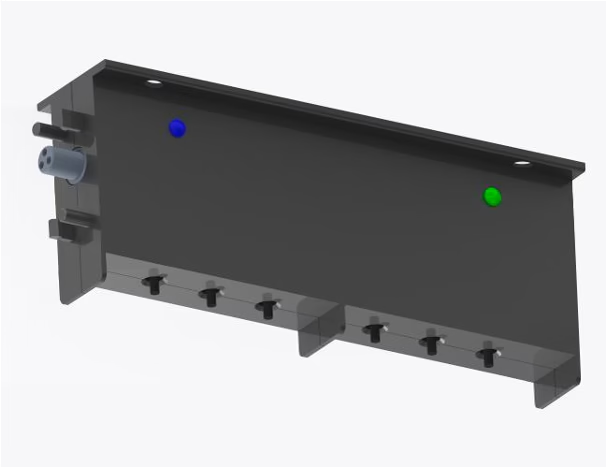
Ion Generation
An ionization device is installed within the HVAC system. This device uses high voltage to create a field with a high concentration of positive and negative ions.
Ion Release
In TBPI systems, ions are released into the airstream one polarity at a time and with a short delay between the polarity swap. Since the ions are separated by a short time delay, little to no recombination will occur in the duct and higher levels of ions can reach the space.

Particle Clustering
Once in the air, the ions seek out and form bonds with various particles, including pollutants, dust, allergens, mold, bacteria, and viruses. When ions agglomerate, they create a charge that attracts additional particles of the opposite polarity. This causes the particles to cluster together, forming larger particles.
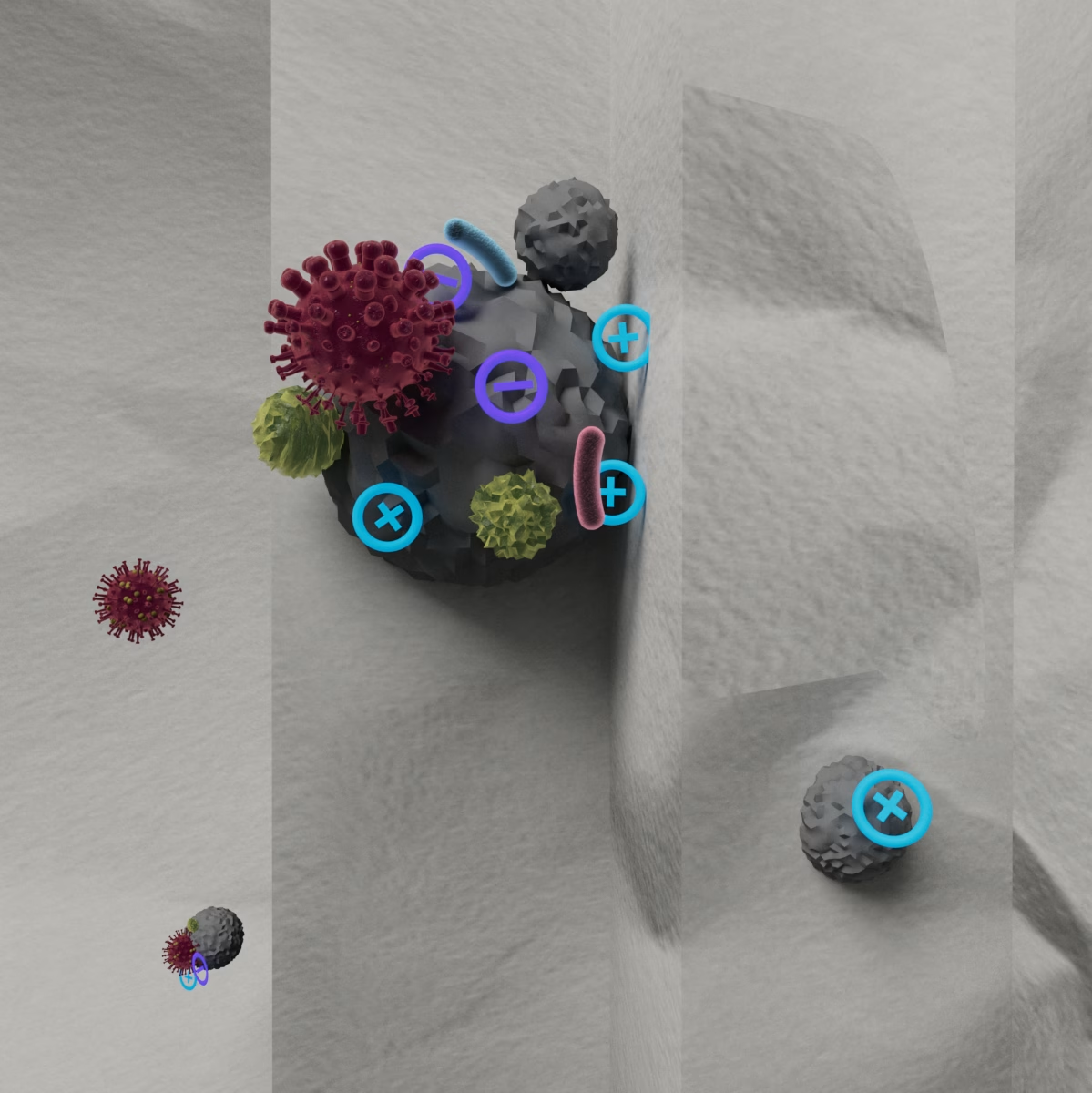
Enhanced Filtration
Larger particle clusters are more easily captured and removed by the HVAC system’s filtration system. This enhanced filtration increases the effectiveness of lower MERV rated filters.

Pathogen Deactivation
Ions produced by TBPI can also deactivate pathogens. When these ions come into contact with pathogens like viruses, bacteria, or mold spores, they disrupt their structure and render them inactive.2
The benefits of using TBPI include:
- Improved indoor air quality: TBPI effectively reduces the concentration of harmful particles and pathogens in the air, leading to a healthier indoor environment.
- Reduced risk of illness: By deactivating pathogens, TBPI can help prevent the spread of airborne diseases.3
- Odor control: TBPI can neutralize odors by agglomeration. Ions polarize VOCs and particles, causing them to stick together. A MERV rated filter should be used to then remove those particles with VOCs and odors attached.
- Energy savings: By cleaning and recirculating indoor air, TBPI can reduce the need for outside air intake, leading to lower HVAC loads and energy consumption.
- Enhanced filtration: TBPI can increase the effectiveness of existing filtration systems by causing particles to cluster together, making them easier to capture.
- Reduced dust: TBPI can significantly reduce dust particles in the air, leading to less dust accumulation on surfaces and a cleaner environment. This can also reduce the need for frequent dusting.
- Static electricity control: TBPI can help reduce static electricity in the air, which can be beneficial in certain environments, such as data centers or electronics manufacturing facilities.4
Potential drawbacks and limitations.
While TBPI offers numerous benefits, it’s essential to be aware of its potential drawbacks and limitations:
- Effectiveness dependent on airflow: The effectiveness of TBPI relies on good airflow and air distribution within the space. Improper installation or inadequate air circulation can limit the reach of ions and reduce their effectiveness. For example, in a large room with poor air circulation, the ions may not be able to reach all areas, resulting in uneven air purification.
- HVAC system dependency: The effectiveness of bipolar ionization can be influenced by the efficiency and settings of the HVAC system. A poorly maintained or inefficient HVAC system can hinder the performance of TBPI. It’s crucial to ensure that the HVAC system is properly maintained and configured for optimal TBPI performance.
- Proper sizing and installation: The effectiveness of TBPI depends on proper sizing and installation of the system. Using an undersized system or installing it incorrectly can limit its ability to effectively purify the air. It’s essential to consult with qualified professionals to ensure proper sizing and installation for optimal performance.
- Not a substitute for ventilation: While TBPI can improve indoor air quality, it should not be considered a replacement for proper ventilation. Adequate ventilation is still crucial for removing carbon dioxide and other pollutants that TBPI cannot address.
- Potential for byproducts: It’s important to select ionization systems that are certified to be ozone-free (UL 867 and UL 2998) to ensure safety and avoid potential health risks.
Tunable needlepoint bipolar ionization is one promising technology for improving indoor air quality and creating healthier indoor environments.
By generating and releasing ions into the air, TBPI can effectively reduce harmful particles, deactivate pathogens, and neutralize odors. Modern TPBI systems are designed to be safe and effective when properly installed and maintained.5
Sources:
- Tierno Jr., Philip M. Cleaning Indoor Air using Bi-Polar Ionization Technology. New York: New York University School of Medicine, April 2017.Schurk, David N. “A Bipolar Ionization Primer for HVAC Professionals.” ASHRAE Journal, vol. 63, no. 6, June 2021, pp. 28–37. ↩︎
- Edward Sobek and Dwayne A. Elias, “Bipolar Ionization Rapidly Inactivates Real-World, Airborne Concentrations of Infective Respiratory Viruses,” PLOS ONE 18, no. 11 (2023): e0293504, https://doi.org/10.1371/journal.pone.0293504. ↩︎
- Waddell C, How Needlepoint Bipolar ionization Reduces Particles, Odors, Pathogens & Energy, Global Plasma Solutions https://globalplasmasolutions.com/uploads/customerresources/Service-Logic/GPS-WhitePaper-NPBI-Explained.pdf ↩︎
- Grabarczyk, Zygmunt. “Effectiveness of Indoor Air Cleaning with Corona Ionizers.” Journal of Electrostatics 51-52 (May 2001): 278-83. ↩︎
- Tierno Jr., Philip M. Cleaning Indoor Air using Bi-Polar Ionization Technology. New York: New York University School of Medicine, April 2017. ↩︎